
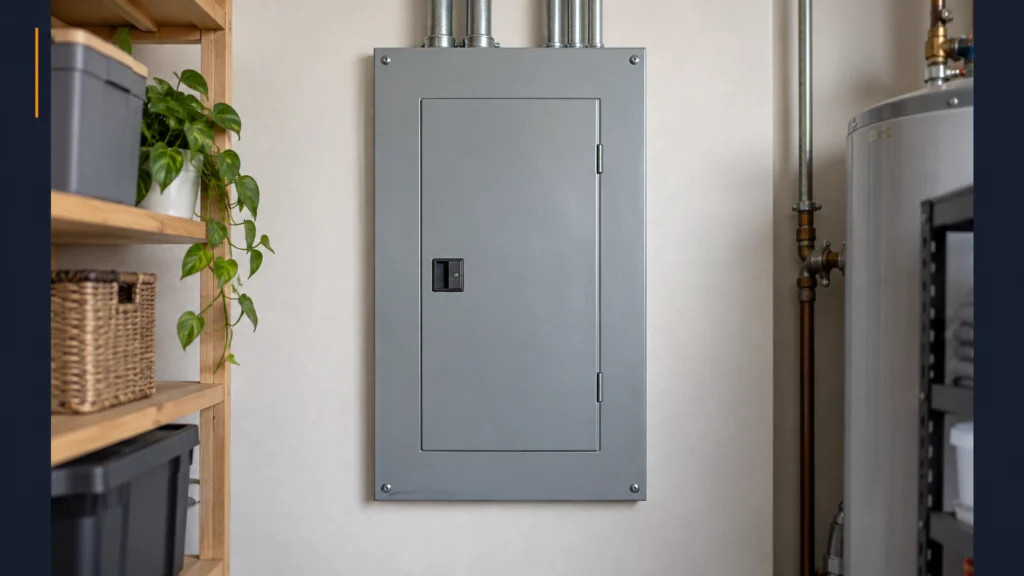
What an Electrical Panel Upgrade Changes Besides Adding Breaker Spaces
An electrical panel upgrade in Columbia, MO is not just a way to add empty breaker spaces. Homeowners usually call because a panel is full, a fuse box is still in service, or lights dim when two large appliances run. The useful question is what else changes when the panelboard, the feeders, or the utility service is replaced, and which of those jobs is actually the one in front of you.
- Adding breaker spaces, replacing an unsafe panel, and increasing ampacity are three different scopes.
- A utility service upgrade is the power company’s work to the house, not the same task as changing the panel inside.
- The federal electric-panel tax credit described by ENERGY STAR applied only to equipment purchased and installed through December 31, 2025.
- Pinnacle’s panel page is the place to request an on-site evaluation and a written scope before work starts.
- A full panel and an undersized service are not the same problem
- What can change inside the panelboard
- What a service change adds that breaker spaces do not
- What to ask before you approve the work
Safety callout: leave the panel cover on. Do not remove breakers or test the bus to see whether you have room. Pinnacle’s upgrade page treats an outdated or overloaded panel as a safety concern and asks for a quote before work starts. Photos of the cover are enough to begin the conversation. The evaluation still happens on site.
A full panel and an undersized service are not the same problem
Breaker spaces are the obvious limit. If every slot is used, a new circuit for a range, a heat pump, or a workshop has nowhere to land. That can be a panel replacement, a subpanel, or a rearrangement of existing circuits. It does not, by itself, mean the service conductors or the utility transformer are too small.
Rewiring America separates those jobs clearly: a panel can be replaced because it is old, degraded, or unsafe without increasing its amperage, and a service or utility upgrade is a different job. New York’s MyEnergy site makes the same split from the other direction. Panel capacity is measured in amps, a 200-amp panel is common for updated equipment, and a home may still need the utility involved if the service from the street cannot support the new load. That utility step can be an additional cost. It is not something an electrician finishes alone.
Pinnacle’s panel upgrade and replacement page describes the Columbia work as upgrading or replacing panels that are outdated, overloaded, or still a fuse box, including homes on 60- or 100-amp service. The page also says the company pulls permits and does the work to code. Those are scope statements from the service page, not a promise that every house needs a larger service.
A Columbia example makes the split concrete. A fuse box, or a 60- or 100-amp service, is one of the conditions the upgrade page tells homeowners to have looked at. That visit may end as a service change. A newer panel that simply has no unused breaker spaces is a different visit: the cover is full, but the service conductors may already be large enough. The electrician should be able to say which of those two houses yours is after looking at the main rating on the existing equipment and the load you described. Guessing from the number of blank knockouts skips that step. Blank spaces are not ampacity, and a crowded cover is not proof the utility transformer is too small.
What can change inside the panelboard
When the work is a panelboard replacement, the visible result is a new enclosure and a new set of breakers. The less visible result is the condition of the connections, the grounding and bonding arrangement, and whether the breakers match the circuits they protect. A crowded panel can hide double-tapped lugs, missing covers, or breakers that no longer match the wire size. Replacing the panel is the chance to correct those conditions, even when the amp rating stays the same.
ENERGY STAR’s electric panel upgrade page describes a different, now-closed federal credit. It says qualifying work could include an improvement to, or replacement of, a panelboard, sub-panelboard, branch circuits, or feeders, installed consistent with the National Electrical Code, with a load capacity of not less than 200 amps, and installed with specified energy equipment. The same page says the credit was for products purchased and installed between January 1, 2023, and December 31, 2025. Do not plan an October 2026 project around that credit. The technical description is still useful: the credit writers treated the panelboard, the branch circuits, and the feeders as part of the same class of work, not as “a few extra spaces.”
A proposal that only says “upgrade” is too vague to approve. Ask the electrician to label three lines: panelboard replacement at the same rating, any increase in ampacity, and any utility or cooperative disconnect. ENERGY STAR’s closed-credit description listed a sub-panelboard next to a panelboard, branch circuits, and feeders. That list is a reminder that extra spaces can be a subpanel rather than a new service. It is not a Columbia requirement, and it is not a price.
None of that decides the amp size of a particular Columbia house. A licensed electrician has to look at the existing service, the calculated load, and the equipment you actually intend to add. Pinnacle’s panel installation and repair page says the team confirms whether a panel needs work on site, not from a photo alone.
What a service change adds that breaker spaces do not
A service change reaches past the panel cover. The installation page says a typical panel and service changeout can take about five to eight hours, permits and inspections from the local electric cooperative are part of the process, and the home should expect to be without power for a full day. That outage is the practical difference. Swapping a breaker does not take the house dark for a day. Changing the service often does, because the utility has to disconnect and reconnect the supply.
MyEnergy notes that the utility service upgrade depends on the current service and the new demand, and that it can add cost. Rewiring America adds the scheduling point without a Columbia-specific claim: coordinating with the utility can delay the date, especially where the crew schedule is tight. Treat those as reasons to ask the question early, not as a timeline for your street.
Charger-load questions belong on the existing Level 2 charger article. The rest of an upgrade is spaces, the condition of the panelboard, the ampacity, and whether the utility service has to change with it.
What to ask before you approve the work
A clear quote separates the pieces. Ask whether the proposal replaces the panel at the same amperage or increases it, whether new feeders or branch circuits are included, and whether the cooperative or utility has to schedule a disconnect. Ask what the permit and inspection cover, and how long the power will be off. If the only problem is one open slot, say so. If the panel is a recalled or damaged brand, or the service is still a small fuse box, the scope is larger than a blank space in the cover.
Pinnacle’s upgrade page invites a quote before work starts and describes the company as licensed and insured. Use that evaluation to get the scope in writing: same rating or a larger service, which circuits move, and whether the utility has to disconnect.
Does a panel upgrade always mean 200 amps?
No. A replacement can correct an unsafe or obsolete panel without raising the amperage. Two hundred amps is a common updated size in the New York guidance, and it was the minimum load capacity in the closed federal credit description. It is not an automatic Columbia requirement stated on Pinnacle’s service page.
Can the tax credit still be claimed in 2026?
ENERGY STAR says that panel credit was for equipment purchased and installed from January 1, 2023, through December 31, 2025. Confirm any later IRS change before you rely on it. The date on the ENERGY STAR page is the one used here.
Who do I call in Columbia?
Request a panel evaluation through Pinnacle Electric’s contact page. Bring the age of the house, any planned equipment, and photos of the existing panel cover if you have them. The electrician still has to see the equipment.
Sources and evidence
Sources used for the general distinctions, not as a substitute for the local inspection: Rewiring America on panel replacement versus a larger service, NY MyEnergy on panel capacity and utility service upgrades, and ENERGY STAR on the closed electric panel tax credit.
Request the on-site panel evaluation through Pinnacle Electric’s contact page. Ask them to separate breaker spaces, panelboard replacement, and any utility service change before you approve the work.